I’ve always been someone who collects things.
Not physical objects, but digital assets. Code snippets, design ideas, icons, fonts, and, over the years, an embarrassing number of colours.
Every project I worked on left behind its own collection of colours. Some lived in Figma, others in CSS variables, screenshots, Adobe files, or random notes I’d forgotten about. Whenever I wanted to reuse a colour from an old project, I had to remember where it came from before I could even begin looking for it.
Eventually I realised I wasn’t managing colours at all. I was managing projects that happened to contain colours.
That didn’t feel right.
Looking for a Solution
Before writing a single line of code, I assumed somebody had already solved this problem.
I spent quite some time searching for a colour management application that worked the way I imagined it should. Not a colour picker, not a palette generator, and not another design tool. I simply wanted a permanent catalogue where I could save every colour I came across, organise them, search them quickly, and reuse them across future projects.
To my surprise, I couldn’t find one.
Most applications treated colours as part of palettes instead of individual assets. Others focused heavily on generating new colour schemes when all I wanted was a place to store existing ones. Some looked promising until I discovered that the free plan only allowed me to save a handful of palettes before asking for a subscription.
I even found services charging around US$4 per month just to save more than five colour palettes.
That felt unnecessary.
A colour is simply data. A HEX value occupies only a few bytes, yet many applications treated storing colours as though it were an expensive premium feature. I wasn’t looking for AI-generated suggestions, team collaboration, or advanced design workflows. I just wanted a searchable library of every colour I’d ever used.
After exhausting my options, I stopped looking.
If the application I wanted didn’t exist, perhaps it was time to build it myself.
Building the Colour Catalogue I Always Wanted
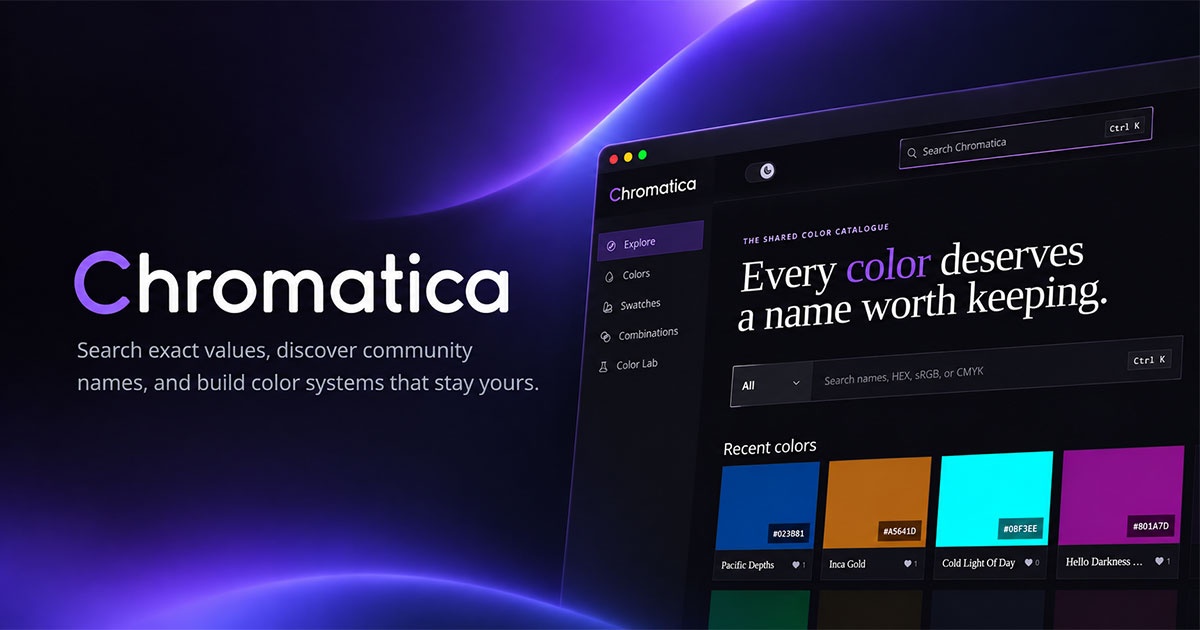
Search exact values, discover community names, and build color systems that stay yours.
That’s how Chromatica began.
The core idea was simple: every colour deserves its own permanent record.
Instead of colours living inside individual projects, they should exist independently. A colour discovered today should still be available years later without having to remember which client, repository or design file it originally belonged to.
As I continued building, the idea naturally expanded.
Individual colours could be grouped into Swatches to represent brands, themes or design systems. Collections of colours working together could become Combinations, allowing me to document not just colours themselves, but how they interact in real-world designs.
One challenge I hadn’t anticipated was naming colours.
Generating a HEX value is easy. Giving a colour a meaningful name is surprisingly difficult. Existing colour libraries only cover a tiny fraction of the millions of colours available. Rather than attempting to invent names for everything myself, I decided Chromatica should eventually allow the community to contribute names over time. A single colour might be known by multiple names, each becoming part of its identity.
Looking back, Chromatica started because I couldn’t find a tool that matched the way I think about colours.
Like many of my side projects, it wasn’t born from trying to build a business. It was born from solving a problem that annoyed me enough to spend my evenings building a solution instead.
This journal will probably become a record of that journey—why certain decisions were made, mistakes along the way, and how Chromatica evolves over time. Whether anyone else ends up using it is almost secondary. The important part is that I’ve finally built the colour catalogue I’ve wanted for years.